Algorithms
Rendering
Grid traversal: DDA
Walks a ray from \(O\) along \(D = (\cos\phi, \sin\phi)\) through the cells it crosses, in order, to the first wall (Amanatides and Woo's traversal, in 2D).
- Crossings of vertical grid lines are \(\Delta t_x = |1/D_x|\) apart along the ray, of horizontal ones \(\Delta t_y = |1/D_y|\).
- Keep the distance to the next crossing on each axis; step the smaller one into the next cell; stop at a wall (or a door the ray meets).
Used for walls, line of sight and aiming. Code: src/Camera/.
Projection
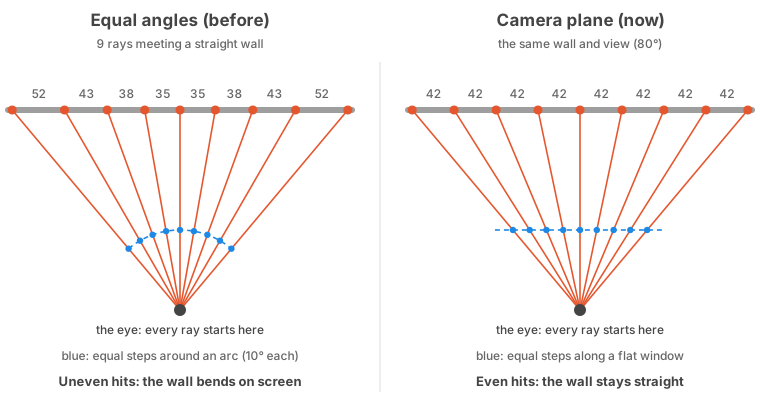
- Perpendicular distance removes the fishbowl bulge: \(d_\perp = t \cos(\phi - \theta)\).
- Wall height on screen: \(h = P / d_\perp\), with \(P\) the pixels a unit is tall one unit away.
- Rays through a flat camera plane, not at equal angles: column \(x\) looks along \(\phi\) with \(\tan\phi = x \tan(\text{FOV}/2)\), \(x \in [-1, 1]\), so straight walls stay straight.
- Texture column: the fractional part of the hit point along the face, times the texture's width.
Painter's algorithm with billboards
- Every wall strip, sprite and decal goes into a queue with its distance; the queue is sorted far to near and drawn in order. A sprite behind a pillar is covered by the pillar's nearer strips: no depth buffer.
- Sprites are billboards: scaled like walls by their distance, turned to face the viewer. An enemy has eight pictures; the one shown depends on the angle between its facing and the viewer.
- Ties keep their submission order (an
orderfield), so an unstable, allocation-free sort is enough.
Code: src/Graphics/src/renderer_3d.cpp, src/Camera/src/camera.cpp.
Simulation
Fixed timestep with interpolation
accumulator += min(frame_time, 0.25 s)
while accumulator >= 1/60 s:  tick(); accumulator -= 1/60 s
alpha = accumulator / (1/60 s)          # draw alpha of the way to the next tick
Positions are drawn \(p = p_{prev} + (p - p_{prev})\,\alpha\); angles take
the short way round, std::remainder(b - a, 2π).
Code: src/TimeManager/.
Collision
- Walls: a square body; only the edge moving towards a wall is tested, at both corners (pulled in by 1% so a body can slide along a wall); x and y are moved and tested separately, so a blocked axis still lets the other slide.
- Bodies: circles; a step ending inside another body is pushed out along the line between the centres, onto its edge; a step moving away is always allowed, so nothing gets stuck.
Code: src/CollisionManager/.
Enemies
State machine
stateDiagram-v2
    [*] --> Idle
    Idle --> Walk: sees or hears the player
    Patrol --> Walk: sees or hears the player
    Walk --> Attack: in range, in sight, its turn
    Attack --> Walk: fired, sidesteps
    Walk --> Retreat: badly hurt, cover found
    Retreat --> Walk: rested, or found
    Walk --> Idle: lost the player
    Walk --> Pain: hit
    Pain --> Walk: recovered
    Pain --> Death: no health left
Hearing: breadth-first flood fill
A shot starts a BFS from its cell through open cells (walls and closed doors stop it), up to the weapon's noise range in steps; every enemy in a reached cell is alerted. Sound goes round corners, not through walls. Buffers are sized once per level.
Code: Scene::MakeNoise.
Pathfinding: weighted A*
- Grid: each map cell is split into 2 × 2, 4-connected.
- Cost: \(f = (1 - w)\,g + w\,h\), \(w = 0.6\), \(h\) the straight-line distance: faster than plain A*, paths at most 1.5 times the shortest (on these open rooms, usually the shortest).
- Extra step costs: +3 on other enemies' next 16 cells (groups split up), +4 beside lamps; cells with other enemies are blocked.
- Open set: a binary heap; a cell reached more cheaply is pushed again and the stale entry skipped when popped (no decrease-key).
- No clearing between queries: each cell's state carries a generation stamp, valid only if it equals the current query's; starting a query is one increment.
Code: src/NavigationManager/src/grid_path_finder.cpp.
Combat
Hitscan against a picture
For a target at distance \(d\) and a shot along \(\hat f\) from the eye:
- the shot crosses the target's board (facing the shooter) at \(along = d / (\hat f \cdot \hat t)\);
- across the picture: \(0.5 + (\hat f \cdot along - \vec t) \cdot \hat r / width\);
- down the picture: \(1 - (0.5 + pitch \cdot along) / height\) (the eye is half a wall up, the shot climbs with the pitch);
- it hits if both are in \([0, 1)\) and the picture's mask is solid there; the zone comes from how far down the solid part it crossed: head (top 20%, ×2 damage), body, legs (bottom 45%, ×0.6).
Pellets are fanned evenly across the weapon's spread, each resolved alone.
Damage over distance
- Linear: \(dmg = min + (max - min)\,\frac{range - d}{range}\)
- Exponential (shotguns): \(dmg = \operatorname{clamp}(e^{(range - d)/1.5}, min, max)\)
Projectiles
Moved in steps of 0.05 cells (less than any body is wide) so nothing is passed through; bursts on a wall, a body or a lamp. The blast hurts each body in reach and in line of sight, falling off linearly to its edge; the shooter takes half.
Code: src/ShootingManager/, Scene::Fly, Scene::Burst.
Audio
Positional gains
For a sound at distance \(d\) and bearing \(\phi\), heard facing \(\theta\):
- loudness \(g = r^2\), \(r = \operatorname{clamp}\left(\frac{24 - d}{22}, 0, 1\right)\), times 0.45 through a wall;
- pan \(s = 0.8 \sin(\phi - \theta)\); \(g_L = g \min(1, 1 - s)\), \(g_R = g \min(1, 1 + s)\).
Lock-free single-producer, single-consumer ring
The game thread writes a command into a fixed array and publishes it with
a release store of its counter; the audio thread reads up to that
counter with an acquire load, and publishes what it took the same
way. Free-running 32-bit counters: sent - taken is the count in flight,
even after they wrap.
Code: src/SoundManager/src/spatial_mixer.cpp.
Memory
- Arena: bumps downwards from the end of one block, so aligning is
one mask (
& ~(alignment - 1)); never grows (running out is an error);Reset()frees a whole level at once. - Pools with generational handles: a handle is an index plus the slot's generation; freeing a slot bumps its generation, so an old handle to a reused slot is detected instead of reaching the wrong object.
Code: src/Allocators/.
Networking
The algorithms of the match (prediction and reconciliation, snapshot interpolation, lag compensation, the command queue, spawn choice, round trips) are on the Multiplayer page.
Downloading
- The file is split into 1 MB byte ranges, fetched over 4 connections.
- Each read has a 2 s watchdog; a piece that stalls is re-requested from the byte it reached, on a new connection (up to 30 times without progress).
- Pieces are streamed out in order as they complete, so the WebAssembly compiles while the rest downloads.
- The result is kept in IndexedDB under the server's size and date, and reused while they match.
Code: web/shell.html.